

 Written by
Running paid ads in healthcare is different from promoting a product. You are talking to scared people, looking for help quickly, or trying to decide between doctors before making a big choice. At the same time, you need to stick to strict rules about ads and respect people's privacy. A single bad word, an ad that doesn't follow the rules, or a landing page that isn't built well can waste your money. Cause your account to be blocked.
That is why the agency you pick is very important. This guide shows you what to look for before hiring a healthcare PPC agency, what to watch out for, and what questions to ask so you can find a partner that brings in leads instead of just clicks.
Why Choosing the Right Healthcare PPC Agency Matters
Patients take their time when choosing a provider. Even after receiving a specialist referral, around 90 percent still research providers before scheduling, according to Kyruus research reported by Healthcare Finance News. That research phase is where your ads need to show up with the right message.
If you are wondering why hire a healthcare PPC agency instead of using a general marketing firm or running ads in-house, the answer comes down to three factors: specialization, compliance, and lead quality.
-
Specialization: Patients search differently from customers. Specialization means they use symptom-based questions. Specialization helps match your ads to what patients want.
-
Compliance: Healthcare ads face platform rules about health information, claims, and remarketing. Compliance requires a team that knows these rules; otherwise, your campaigns might be stopped.
-
Lead quality: More clicks do not equal more patients or partners. Lead quality focuses on appointment bookings, inquiries, and demo requests rather than just traffic.
Understanding the 5 P’s of Healthcare Marketing
It is helpful to understand the foundation of effective healthcare marketing before evaluating an agency. Each of these five areas should be connected to your advertising campaign by a competent medical PPC agency.
1. People
Your audience is made up of groups: patients, caregivers, doctors who refer patients, hospital administrators, and, in the B2B world, procurement teams and clinic owners. Each group thinks differently. Cares about different things. So your agency should design campaigns that speak directly to each group using messages that fit their needs and questions.
2. Product
In healthcare, your "product" isn’t always a thing. It’s your service, treatment, specialty, or health solution. Your ads should clearly show what sets you apart, like expert doctors, advanced technology, or better patient outcomes. Always stay truthful and follow the rules.
3. Price
Money matters in healthcare. Patients often look for costs, whether insurance covers the service, and what payment options are available. Your PPC campaigns should answer these questions honestly. Point people to clear, easy-to-find pricing info on your website.
4. Place
This means people can find you, both physically and online. For clinics and hospitals, that’s search ads and keywords that match people looking nearby. For B2B healthcare businesses, it’s being seen on the websites and search terms that decision-makers use to find solutions.
5. Promotion
This is where PPC fits in: search ads, display banners, remarketing (like Google Ads Remarketing), and landing pages built for getting results. A good agency sees promotion not as a one-off tactic. As part of a bigger plan that works with everything else.
10 Things to Check Before Choosing a Healthcare PPC Agency
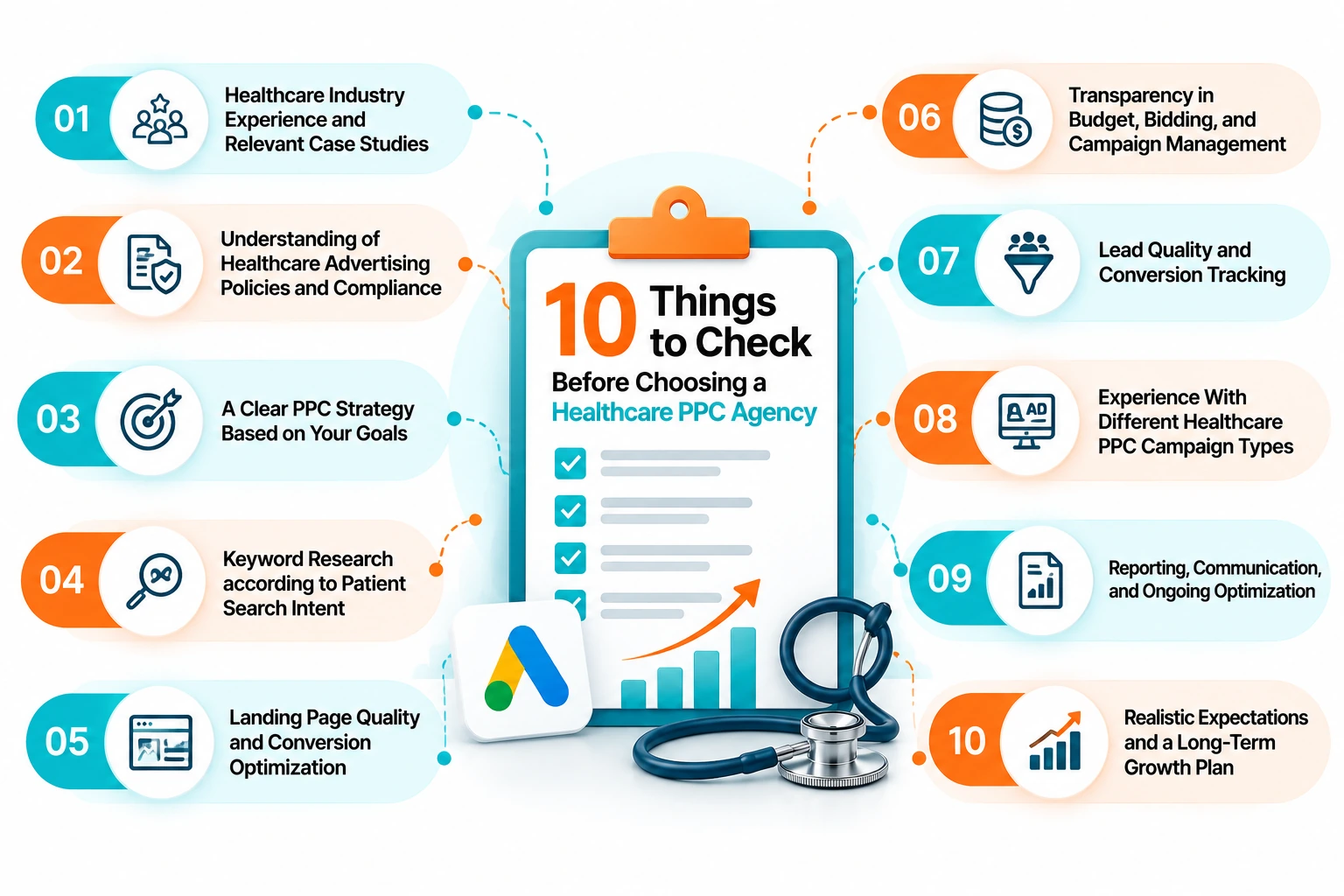
Not every agency that runs Google Ads can do a job for healthcare. The real difference comes down to how the agency understands patient behavior, advertising rules and what makes a lead truly valuable.
Use these 10 checkpoints to help you evaluate a healthcare PPC agency. Each one helps you decide if the agency can protect your budget follow the rules and bring in leads, not just clicks.
1. Healthcare Industry. Relevant Case Studies
Start by asking for proof. Don’t just take their word for it. Ask for case studies from healthcare clients in a specialty that matches yours, like dental, diagnostics, hospitals, telemedicine, medical devices or healthcare technology.
Look for results that go beyond surface-level stuff like impressions and clicks. Real proof shows lead volume, cost per lead, appointment bookings or pipeline growth. These numbers matter.
2. Understanding of Healthcare Advertising Policies and Compliance
Google Ads and other platforms have rules for healthcare and medicine. There are restrictions on advertising for sensitive health conditions, limits on certain claims, and strict rules around prescription-related ads.
Ask the agency how it handles:
-
Platform policy requirements for health-related ads
-
Ad copy that avoids exaggerated claims
-
Patient data privacy and applicable regulations, in your region
-
Ad disapprovals and account suspensions
An agency that cannot explain its compliance process in simple clear terms is a serious risk. You need someone who knows the rules and follows them every day.
3. A Clear PPC Strategy Based on Your Goals
A good agency does not start by building ads. A good agency starts by understanding your business. I would say that the best agencies focus on your business first. Whether you want appointment bookings, higher patient inquiries, or better healthcare lead generation the strategy should be built around that goal.
Ask about the agency's plan for the 90 days. You should hear about audience research, campaign setup, budget planning, and how success will be measured.
4. Keyword Research According to Patient Search Intent
Healthcare searches vary widely. Someone searching “symptoms of back pain” is researching, while someone searching “orthopedic doctor near me” is ready to book. A skilled agency separates these intents and builds campaigns accordingly.
Make sure the agency:
-
Builds keyword lists around patient and decision-maker intent
-
Uses negative keywords to filter out irrelevant or low-value searches
-
Targets location-based and service-specific terms
-
Avoids bidding on broad terms that burn budget without conversions
5. Landing Page Quality and Conversion Optimization
Even the best ads fail if the landing page is slow, confusing, or untrustworthy. Healthcare users want clear information, credibility signals, and an easy next step.
A reliable agency will either build or advise on landing pages with:
-
Fast loading speed and mobile-friendly design
-
Clear headlines that match the ad message
-
Trust elements such as doctor credentials, certifications, and testimonials
-
Simple forms and visible call-to-action buttons
6. Transparency in Budget, Bidding, and Campaign Management
You should always be aware of where your money's going. Find out how the company organizes its charges if the advertising costs are charged separately from the management fees and who has ownership of the advertising accounts.
Make sure you get access to your own Google Ads account and information. Openness about the methods used to place bids, any changes to the budget, and the choices made about the campaigns is a sign of a good company.
7. Lead Quality and Conversion Tracking
Lead volume might be deceptive on its own. Results such as phone calls, form submissions, chat messages, and planned appointments will be monitored by a strong agency.
This is particularly crucial for B2B healthcare lead generation, since a single high-quality lead, like a clinic owner or hospital procurement manager, can be worth more than dozens of uninterested queries.
You must understand how the agency distinguishes between high-interest and low-interest leads.
8. Experience With Different Healthcare PPC Campaign Types
Healthcare PPC is not just search ads. Depending on your goals, you may need a mix of:
-
Search campaigns for high-intent queries
-
Display and video campaigns for awareness
-
Local campaigns for clinics and hospitals
-
Remarketing, where allowed by policy
-
Campaigns targeting healthcare professionals and businesses
The right agency recommends a mix based on your goals and budget instead of pushing one format for everyone.
9. Reporting, Communication, and Ongoing Optimization
PPC that works is never just. Left alone. Ask how often you will get reports and what numbers they are. How often you can talk to your account manager.
Helpful reports are more than clicks and impressions. They should show cost per lead, conversion rate, lead quality, and what the agency will try to improve. Regular optimization calls keep the campaigns in line with your objectives.
10. Realistic Expectations and a Long-Term Growth Plan
PPC can give you visibility, but real success doesn’t happen overnight. It takes time, testing, and constant tweaking. A good agency will be honest about how long things take and won’t promise miracles. They know that results grow steadily.
You should look for an agency that focuses on long-term growth. They should talk about scaling campaigns that already work, making your conversion rates better over time and using PPC in combination, with SEO and content. That’s how you get results, not just a short burst of traffic.
Marketing Agency Red Flags to Avoid When Hiring a Healthcare PPC Agency
Knowing what to look for is half the job. Knowing what to avoid is the other half. Here are the most common marketing agency red flags to avoid during your selection process.
|
Marketing Agency Red Flag |
Why It Matters |
What to Check Instead |
|
Guaranteed leads or immediate results |
Competition, patient behavior, and auction dynamics are uncontrollable. Guarantees frequently indicate deceptive or unrealistic behavior. |
Ask for realistic timelines, benchmarks, and a clear testing plan. |
|
No healthcare-specific experience |
Healthcare has unique audience behavior and strict ad policies that generalists often miss. |
Request healthcare case studies and examples of similar campaigns. |
|
Limited knowledge of healthcare advertising policies |
Policy violations can lead to ad disapprovals or account suspensions. |
Find out how they manage compliance and what their review procedure entails. |
|
Unclear pricing and hidden fees |
Hidden charges make it hard to measure return on investment. |
Get a written breakdown of management fees and ad spend. |
|
Reporting only clicks and impressions |
These vanity metrics do not show whether campaigns are producing patients or revenue. |
Look for reports on cost per lead, conversions, and lead quality. |
|
No clear conversion tracking process |
Without tracking, you cannot tell what is working. |
Ask how they track calls, forms, and bookings. |
|
Generic campaign strategies |
Copy-paste strategies ignore your specialty, location, and audience. |
Ask for a customized plan based on your goals and market. |
|
Poor communication and infrequent updates |
Slow responses often lead to slow optimization and missed opportunities. |
Confirm reporting schedules and a dedicated point of contact. |
Can the Agency Run PPC Services for Healthcare Across All the Right Platforms?
Your patients and decision-makers don't spend their time on one platform. A patient might search on Google. A clinic owner could scroll through LinkedIn. A hospital buyer may watch a product video on YouTube.
When you look for PPC services for healthcare, make sure the agency can work across platforms. They should suggest the mix for your goals. Don't let them push one platform just because that's what they know best.
Every platform has its healthcare advertising rules so the best PPC agency for healthcare must know all of these rules. PPC services that operate on platforms are far more helpful than those that operate on just one.
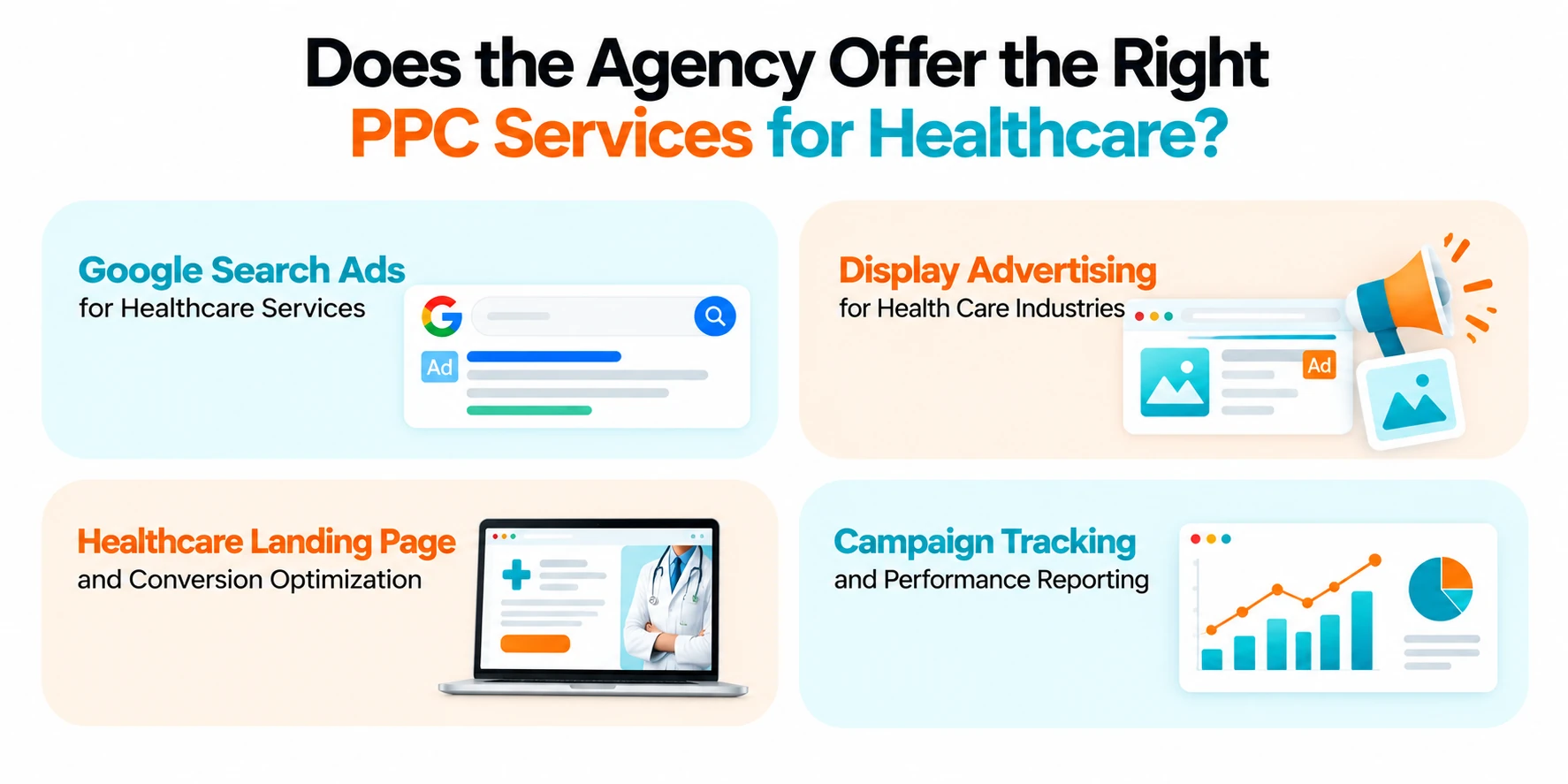
Google Ads: Search and Local Campaigns
Google Ads often serves as the first step for healthcare PPC. Google Ads reaches people who are searching for a doctor, a clinic, a treatment, or a health solution. The agency must build campaigns that concentrate on topics, locations, and user intentions.
The ads should follow the rules. Have proper text and features like call buttons and location information. The agency also needs to know the rules that Google has for healthcare ads, including limits on types of health-related advertisements.
Display and Video Advertising (Google Display Network and YouTube)
Display advertising for healthcare industries helps build awareness and keeps your brand visible while people look into their options. It’s good for making sure people remember your brand, promoting events, and reaching professional groups.
Video ads on YouTube can help build trust, especially when they show doctors speaking or explain things to patients. Because of the rules around health care advertising, the agency needs to know which ways to target and retarget audiences are allowed.
Meta Ads (Facebook and Instagram)
Meta platforms help raise awareness, build communities, and promote services such as wellness programs, health checkups, or elective treatments. However, Meta enforces limits on targeting and messaging about health conditions and personal attributes. Ask the agency how it creates creatives and audiences without crossing those lines.
LinkedIn Ads for B2B Healthcare Lead Generation
If you sell to hospitals, clinics, or healthcare professionals, LinkedIn is a strong platform to reach them. LinkedIn has reported more than 6 million healthcare buyers from more than 635,000 companies on its platform.
You can target them by job title, industry, and company size, which makes LinkedIn especially useful for B2B healthcare lead generation. It works well for promoting medical devices, healthcare software, or consulting services with greater precision.
Make sure the agency can build lead-gen campaigns that feed into your sales process, rather than chasing the number of form fills. What you need are leads that turn into sales.
What Questions Should You Ask a Medical PPC Agency Before Hiring?
A strong conversation with a medical PPC agency reveals a lot about lead quality and conversion tracking. Asking the questions is only half the job, though. You also need to know what a good answer sounds like and which responses should make you pause. Use the guide below during your discovery calls.
1. How many healthcare clients have you worked with, and in which specialties?
-
Good answer: The agency lists the specialties it has worked in such, as dental, diagnostics, hospitals or healthcare technology. It provides a number of clients it has served. Then it explains how that experience connects directly to your niche.
-
Weak answer: “The company works with all industries and healthcare is just another vertical”.
2. Can you share case studies with measurable results?
-
Good answer: The agency shares case studies with clear numbers such as cost per lead, appointment bookings, or pipeline growth, and explains what was done to achieve them.
-
Weak answer: The agency only shows screenshots of clicks and impressions, or says all its case studies are confidential and offers nothing similar.
3. How do you ensure our ads comply with healthcare advertising policies?
-
Good answer: The agency describes a review process, mentions platform-specific rules (Google, Meta, LinkedIn), and explains how it handles disapprovals and sensitive health terms.
-
Weak answer: “We’ve never had any problems,” or “The platform will tell us if something is wrong.” Compliance should be proactive, not reactive.
4. What does your onboarding and first 90 days look like?
-
Good answer: A clear timeline covering account audit, goal setting, audience and keyword research, campaign launch, testing, and the first optimization review.
-
Weak answer: A vague “we’ll get started right away” with no plan, milestones, or discussion of your goals.
5. How do you research keywords based on patient search intent?
-
Good answer: The agency explains how it separates research-stage searches from ready-to-book searches, uses negative keywords, and targets service and location terms.
-
Weak answer: The agency plans to bid on broad, high-volume terms without discussing intent or cannot explain how it filters out irrelevant searches.
6. How will you track calls, form fills, and booked appointments?
-
Good answer: The agency sets up conversion tracking for calls, forms, and chat, and can connect this data to your CRM or booking system while respecting patient privacy.
-
Weak answer: “We’ll track clicks and traffic.” If calls and bookings are not tracked, you cannot judge real performance.
7. What metrics will you report, and how often?
-
Good answer: Regular reports (weekly or monthly) covering cost per lead, conversion rate, lead quality, and next steps, along with scheduled review calls.
-
Weak answer: Reports focused on impressions and clicks, or a promise to share updates “when needed.”
8. Who owns the ad accounts and data?
-
Good answer: You own the ad accounts, and the agency is added as a manager. You have full access to data and reports at any time.
-
Weak answer: The agency runs campaigns under its own account, or says you can access data only through its reports. This can leave you stuck if you decide to leave.
9. How do you separate high-quality leads from low-intent ones?
-
Good answer: The agency uses qualifying form fields, call tracking, lead scoring, and feedback from your team, and optimizes campaigns toward quality instead of volume.
-
Weak answer: “A lead is a lead.” This approach often means more inquiries but fewer patients or customers.
10. How do you handle underperforming campaigns?
-
Good answer: The agency explains how it diagnoses the problem (keywords, ad copy, landing page, targeting, or budget), tests changes in a structured way, and keeps you informed.
-
Weak answer: The agency blames the industry or your budget without offering a plan, or suggests simply increasing spending.
11. What is your fee structure, and are there any additional costs?
-
Good answer: A written breakdown that separates the management fee from ad spend, with all setup, reporting, or creative costs listed upfront.
-
Weak answer: A single bundled price with no breakdown or fees that are unclear until after you sign.
12. What realistic results can we expect, and in what timeframe?
-
Good answer: The agency gives honest ranges based on your specialty, location, and budget and explains that early months involve testing and learning.
-
Weak answer: Guaranteed leads, fixed rankings, or promises of fast results. No one can control auction dynamics or patient behavior.
Pay attention not only to the answers but also to how clearly and confidently they are given. An agency that explains its process in plain language and is comfortable being asked tough questions is far more likely to be a reliable long-term partner.
Final Checklist Before Hiring a Healthcare PPC Agency
Use this quick checklist before you sign any agreement:
-
The agency has proven healthcare experience and relevant case studies
-
It understands healthcare advertising policies and compliance
-
It offers a strategy tailored to your goals, not a template
-
Keyword research is based on patient and decision-maker intent
-
Landing page and conversion optimization are included or supported
-
Pricing, fees, and bidding approach are transparent
-
Conversion tracking measures calls, forms, and appointments
-
A suitable mix of campaign types is offered
-
Reporting is regular, clear, and focused on business outcomes
-
Expectations are realistic, with a long-term growth plan
-
You have full access to your ad accounts and data
If an agency checks most of these boxes, you are likely on the right track.
Conclusion: Choose a Healthcare PPC Agency That Prioritizes Results and Transparency
Choosing a healthcare PPC agency is a decision that directly affects your patient flow, your brand reputation, and your marketing return. By checking industry experience, compliance knowledge, strategy, tracking, transparency, and communication, and by watching for the red flags above, you can avoid costly mistakes and find a partner who truly understands your goals.
At DIGITECH India, we help healthcare brands, clinics, and medical businesses grow with performance-driven PPC campaigns built on compliance, clear reporting, and a deep understanding of patient and decision-maker intent. Whether you need healthcare lead generation, B2B healthcare lead generation, or full-funnel PPC services for healthcare, you can consider DIGITECH India, the best ppc agency for healthcare, and we are ready to build a strategy that fits your goals.
Ready to generate high-quality healthcare leads? Contact DIGITECH India today for a free consultation and discover how the right PPC strategy can grow your practice or business.


