

 Written by
Parasite SEO in 2026 is not like the game marketers used to play a few years back. The idea is straightforward: publish your content on a trusted authority third-party site and use that site’s strong reputation to help your own content rank. For a time this was a popular shortcut to getting on the first page of search results.
Now Google sees the overuse of this method as spam. With AI search engines changing the way things work, third-party content is no longer what it used to be. It’s not about visibility anymore. It’s about how useful the content's how relevant it is and how it fits into the new search experience. The rules have shifted. The game has changed.
So does parasite SEO still work in 2026? Sometimes, but not the way it used to. This guide covers what has changed, which platforms still work, how to measure results, and how to decide whether it belongs in your strategy. If you’re looking for a parasite SEO 2025-2026 which platforms still work as a strategy guide, you’re in the right place.
What Has Changed About Parasite SEO in 2026?
Parasite SEO, which means publishing content on high-authority third-party websites to rank faster than a new site could on its own, still exists, but the rules around it have changed.
Search engines have become much better at spotting content that is placed on a trusted domain mainly to take advantage of its reputation. Google has also tightened its policies on third-party content that offers little value to the host site’s own audience. Below are the key shifts that matter if you are using this approach today.
From Borrowing Domain Authority to Earning Search Visibility
The old playbook was to buy or place a page on a strong domain, stuff it with keywords, and wait for rankings. The new reality rewards content that is useful on its own merits. A third-party page now has to earn visibility through relevance, expertise and real value to readers, not through the host site’s authority alone.
Think of it as a shift from borrowing authority to earning attention. Your content has to deserve its position, whichever domain hosts it. This matches the broader direction of Google’s search spam policies, and it’s why a strong SEO content strategy is a better foundation than any single hack.
Why Google’s Site Reputation Abuse Policy Matters More Than Ever
Understanding the Google parasite SEO policy is now essential. Google introduced its site reputation abuse policy with the March 2024 core update. Google describes it as stopping third-party content that is published on a trusted site just to exploit that site’s reputation and rank higher.
Here is what matters in 2026:
-
The policy is still active. Site reputation abuse remains a listed spam violation, and site owners are still notified through Search Console when a manual action is applied.
-
Enforcement targets sections, not whole sites. A manual action affects the abusive portion of the host site, and the rest of the site is not affected.
-
There is a regional change. On August 28, 2026, Google announced that, beginning August 30, manual actions will work differently for searchers in the European Economic Area. Outside the EEA, a manual action still directly affects the results. Inside the EEA, the affected section may instead be separated in Google’s systems so that it ranks independently over time. Google said the change followed discussions with the European Commission.
How AI Search Is Changing the Purpose of Third-Party Content
Third-party content is no longer only about blue-link rankings. AI search tools such as ChatGPT, Perplexity, Gemini and Google’s AI Overviews pull answers from across the web, and they lean heavily on community and publisher sites.
In a Peec analysis of 30 million cited sources (March 2026), Reddit ranked first or second on every AI engine tested. The same study’s top-10 list also placed LinkedIn third and Medium ninth.
So the goal has expanded. Third-party publishing can now earn citations and brand mentions in AI answers, not just rankings. Our guide to generative engine optimization explains this shift in more depth.
Does Parasite SEO Still Work in 2026? An Effectiveness Breakdown
The short answer is that it can, but it is no longer a reliable shortcut. Results now depend far more on the quality of the content, the relationship with the host site, and the intent behind the page than on the host’s domain strength alone.
Some placements still earn rankings, while others get filtered out or lose visibility over time. The sections below explain when it can still work, where it tends to fail, and what to weigh before you invest in it.
When Parasite SEO Can Still Generate Google Rankings
Parasite SEO and Google rankings in 2026 can still go together under specific conditions. Rankings are most likely when:
-
the content is genuinely helpful, original and written by someone with real expertise
-
the host site actively reviews or oversees what is published, rather than renting out a section
-
the topic is relevant to the host site’s main purpose
-
the page is not built purely to manipulate rankings
Google’s definition of abuse centres on third-party pages published with little or no first-party oversight, with the purpose of exploiting the host’s ranking signals. Content that is genuinely editorial and relevant sits on the safer side of that line.
Why High-Authority Websites No Longer Guarantee Results
A big domain name is no longer a shortcut. Three things work against it:
-
Policy risk. A page that violates the policy can be demoted along with its whole section.
-
Volatility. Platform behaviour changes. The same Peec study cautions that both Google and ChatGPT have pulled back from Reddit in the past, so relying on one platform carries concentration risk.
-
Weak content gets ignored. Authority helps a page get crawled and considered, but it can’t rescue a thin or off-topic page.
Parasite SEO 2026 Effectiveness Across Different Search Goals
Parasite SEO 2026 effectiveness depends heavily on what you want to achieve:
| Search goal | Effectiveness | Notes |
| Quick Google rankings for competitive commercial terms | Low and risky | The most likely target of spam enforcement |
| Visibility for informational or experience-led queries | Moderate | Works best with genuine, expert content |
| Brand awareness and authority | Moderate to high | Strong when paired with a consistent expert voice |
| AI search citations and brand mentions | Promising but volatile | Platforms like Reddit, LinkedIn and Medium are frequently cited |
| Long-term organic growth | Low as a standalone tactic | Owned content remains the foundation |
Which Parasite SEO Platforms Still Work in 2026?
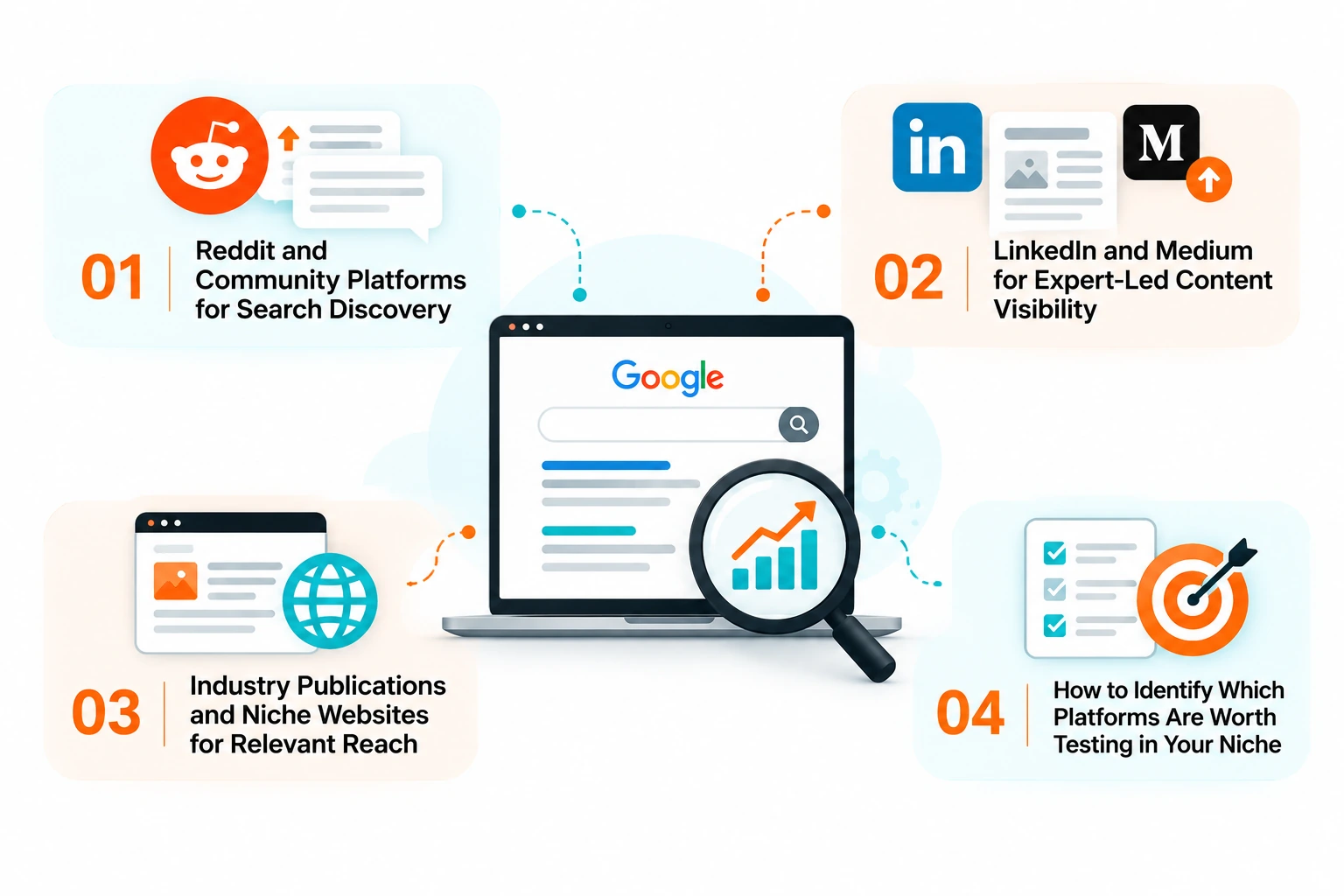
Reddit and Community Platforms for Search Discovery
Reddit remains the most visible community platform in AI search. Profound’s analysis of more than 4 billion AI citations found Reddit accounts for 3.11% of citations across platforms, and that most cited Reddit posts have fewer than 20 upvotes and 20 comments. Question-and-answer threads make up over half of cited Reddit content.
The lesson is that helpful, specific, experience-based answers win. Self-promotion does not. Communities also remove spam quickly, so participate as a real contributor.
LinkedIn and Medium for Expert-Led Content Visibility
LinkedIn and Medium suit expert-led content. Publishing original analysis, case studies and opinions under a real author’s name builds credibility, and both platforms appeared in Peec’s top-10 most-cited domains. They work best when your articles reflect real experience, and they pair well with strong thought leadership content on your own site.
Industry Publications and Niche Websites for Relevant Reach
Relevant industry publications and niche sites often deliver the safest value. A guest article on a respected trade site, with editorial review and a real topical fit, is the opposite of the oversight-free content Google targets. The audience is closer to your buyers, and the link and mention are earned.
How to Identify Which Platforms Are Worth Testing in Your Niche
Not every niche behaves like the global averages. Use this checklist before investing:
-
Check where your audience asks questions. Search your target keywords and note which third-party domains already rank.
-
Check AI answers. Ask ChatGPT, Perplexity and Gemini your customers’ questions and see which sources they cite.
-
Review the platform’s rules. Avoid anywhere that sells “ranking slots” with no editorial oversight.
-
Start small. Run a limited test of 3 to 5 pieces per platform before scaling.
-
Check editorial standards. Prefer hosts that review and care about what they publish.
Platform choice matters, because one study of over a million citations found community forums as a whole account for under six percent of citations, even though Reddit leads as a single domain. Don’t mistake one platform’s strength for a guarantee across the category.
How to Measure Parasite SEO Results Beyond Google Rankings
Track Third-Party Page Rankings for Target Keywords
Start with the basics. Track your third-party pages for your target keywords in a rank tracker, and record the date, platform, keyword and position. Check whether rankings hold over weeks, not days. Quick spikes are common and often fade.
Measure Referral Traffic and Assisted Conversions
Rankings alone don’t prove value. In GA4, tag your links with UTM parameters and measure:
-
referral sessions from each platform
-
engagement quality (time on page, pages per session)
-
assisted conversions, since many users read a third-party article and convert later through another channel
Our guide to GA4 conversion tracking shows how to set this up.
Monitor Brand Mentions and AI Search Citations
Because AI answers now influence discovery, track whether your brand is mentioned or cited. Test a fixed set of prompts monthly across the major AI tools, and use brand-monitoring tools to log mentions. Record which pages are cited, because as noted above, cited Reddit threads can change from month to month.
Identify When a Platform Stops Delivering Results
Set clear exit signals:
-
rankings or citations drop for several consecutive months
-
the platform announces policy or algorithm changes
-
referral traffic or conversions fall below your threshold
-
your content is removed or flagged
When a platform stops delivering, move your effort elsewhere. Don’t keep investing out of habit.
Parasite SEO vs. Traditional SEO in 2026: Which Strategy Should You Prioritize?
Parasite SEO and traditional SEO are often presented as rivals, but they work on different timelines and carry different risks.
Traditional SEO builds visibility on a site you own, which takes longer but gives you lasting control over your rankings, content, and data. Third-party publishing borrows reach from platforms you don’t control, so results can change if the host’s rules or policies do.
Deciding which to prioritize depends on your goals, your resources, and how much risk you are comfortable with. The sections below break down where each approach fits.
When Third-Party Publishing Can Complement Your SEO Strategy
Third-party publishing works as an extension of your strategy, not a replacement for it. It’s useful for reaching audiences who don’t yet know you, earning credibility through trusted publications and testing topics before you invest in them on your own site.
Why Your Own Website Still Matters for Long-Term Organic Growth
You don’t own a third-party page. The host can change its rules, remove the content or lose its rankings. Your website is the only asset you fully control, so it should carry your core pages, your best research and your conversion paths. Strong technical SEO and a solid on-page SEO foundation compound over time in a way rented visibility can’t.
How to Balance External Visibility With Owned Content
A practical split to start from:
-
Most of your effort goes to owned content. Build pillar pages, case studies and resources on your own domain.
-
A smaller share goes to external publishing. Use it to extend reach, not to replace your site.
-
Link the two. Every third-party piece should lead readers back to a relevant page on your website.
What Is the Future of Parasite SEO Beyond 2026?
Parasite SEO is unlikely to disappear, but it is unlikely to stay the same either. Search engines keep refining how they treat third-party content, and AI-generated answers are changing where and how that content gets seen.
Rather than chasing the tactics that work today, it is more useful to understand the direction things are moving, so your strategy still holds up when platforms and policies shift. Here is what to expect and how to prepare.
Why Content Quality and Editorial Relevance Will Remain Central
Enforcement is getting more targeted, not more lenient. Even with the EEA adjustment, Google has restated its commitment to the policy. Content that is relevant, reviewed and genuinely useful will keep its value whatever happens to specific platforms.
The Growing Importance of Search Visibility Across Google and AI Platforms
Search is no longer only Google. Visibility now means appearing in traditional results, AI Overviews, chatbot answers and community discussions. Brands that build consistent, trustworthy visibility across these surfaces will be better protected against any single algorithm change.
How to Decide Whether Parasite SEO Belongs in Your 2026 Strategy
Ask yourself:
-
Can I publish genuinely helpful, expert content on the platform?
-
Does the host review or oversee what’s published?
-
Would the page still deserve to exist if the host’s authority didn’t matter?
-
Am I measuring beyond rankings, including traffic, conversions and citations?
-
Is my own website strong enough to capture the demand I create?
If the answer to most of these is yes, test it carefully. If you’re only after a ranking shortcut, skip it.
Conclusion
Parasite SEO in 2026 is not dead, but the shortcut version is. Google’s site reputation abuse policy is still in force, AI search has changed what third-party content is for, and the winners are brands that publish genuinely useful content and build on a strong owned website. Treat external platforms as a way to extend your reach, and measure the results honestly.
If you need help building a search strategy that balances owned content, third-party visibility and AI search, DIGITECH India can help. Our team combines SEO, content marketing and data-driven reporting to build visibility that lasts. Get in touch with DIGITECH India today to turn your search strategy into measurable growth.


