

 Written by
A few years ago, every marketer had a clear goal: get to the top of Google. That’s still important. Things have changed. Now many people never even get to that page. They type their question into ChatGPT, Gemini, Perplexity, or Google’s AI Overviews. They read an answer made by the AI. Then they move on. Often they click one or two links from the list of sources.
This shift is huge. Google AI Overviews reaches about 2.5 billion people every month. ChatGPT has around 1 billion users. Gemini draws in about 900 million. That’s an audience. If your website isn’t one of the few sites these AI tools pull from, you’re not showing up at all. Even if your Google rankings look strong, you could still be invisible.
There is good news. The sources that AI tools pick aren’t chosen at random. They follow patterns. You can influence which sites get cited. This guide will explain how AI platforms pick their sources. It will cover what to change on your web pages and your whole site. It will show you how to track whether those changes are working.
What Is AI Search Engine Visibility (and Why Citations Are the New Rankings)
AI search engine visibility is how often, and how prominently, your brand or content shows up inside AI-generated answers. That can mean a clickable citation, a named mention in the response text, or a recommendation when someone asks for “the best” of something in your category.
It matters because the click has moved. In a classic search result, ten blue links compete for attention. In an AI answer, a few sources get woven into one response, and everyone else gets nothing. Citations are effectively the new rankings: you’re either part of the answer or you aren’t.
Here’s the part that surprises most marketers. Strong Google rankings don’t guarantee AI citations. Ahrefs found that only about 12% of URLs cited by AI assistants rank in Google’s top 10 for the original prompt. A separate Ahrefs study of 863,000 keywords reported that the share of AI Overview citations coming from top-10 pages has dropped to roughly 38%, down from 76% a year earlier.
In plain terms, each platform has its own taste. Treating “AI search” as one channel is the first mistake. Treating it as a separate discipline from SEO is the second, because the fundamentals still overlap heavily. More on that below.
How AI Platforms Decide Which Websites to Cite
While the precise formulas are not known to anyone outside these companies, there are some clear patterns that have emerged from research on AI search and citations. Most platforms prefer content that's easy to understand, trustworthy, relevant, and up to date.
They extract chunks of text, not full pages. The AI systems tend to segment content into sections and assess them accordingly. A paragraph that answers a question or explains a concept clearly or gives a useful definition is likely to be chosen rather than general text that relies on context.
They prefer concrete and tangible data. The use of relevant statistics, expert quotes, credible references, and evidence-based explanations has been shown to boost visibility in AI-generated answers. Content should show knowledge, and knowledge of the material should be useful. It is better to have clear and useful writing than keyword stuffing.
They are using authority that isn't your site. AI platforms are not just judging your website by itself. They can use information from trusted sources such as books or community debates, and reference sites, video platforms, and other information sources. Independent mentions, expert contributions, credible reviews, and editorial coverage can build your brand reputation and enhance its visibility in AI-powered search experiences.
They prefer fresh and clean material. AI systems are likely to be looking for up-to-date information on facts, products, industry trends, and best practices. Checking articles regularly, updating outdated content, checking references and adding relevant input can be useful to have the content up to date. Updates should make changes to the content on a page, and not just change the publication date.
Each platform has its way of citing information.
-
Google AI, AI Mode mix AI-generated answers with search-based discovery. Good SEO basics, content that's relevant a clear structure, and helpful multimedia can help with being seen.
-
ChatGPT can use reference websites, community talks, editorial publications, and other related sources. Full guides, comparison articles, and organized content can help answer questions from users.
-
Perplexity focuses on answers that have sources linked and often sends users to material that backs up its statements. Original research, official documentation, and information that is clearly given can make content for its way of finding things.
-
Gemini and Claude have their own ways of finding information and their own preferences for sources. Publishing content that is well-structured and building trust across reliable sources can help make your information more helpful for these systems.
The main point is that a good AI visibility plan is more than regular SEO. Make content that directly answers questions people have, back up statements with proof, keep things up to date, and get praise from trusted places on the web. Instead of making content for just one platform, focus on creating a reputation for being a dependable and helpful source of information.
How to Improve AI Visibility and Citation Worthiness
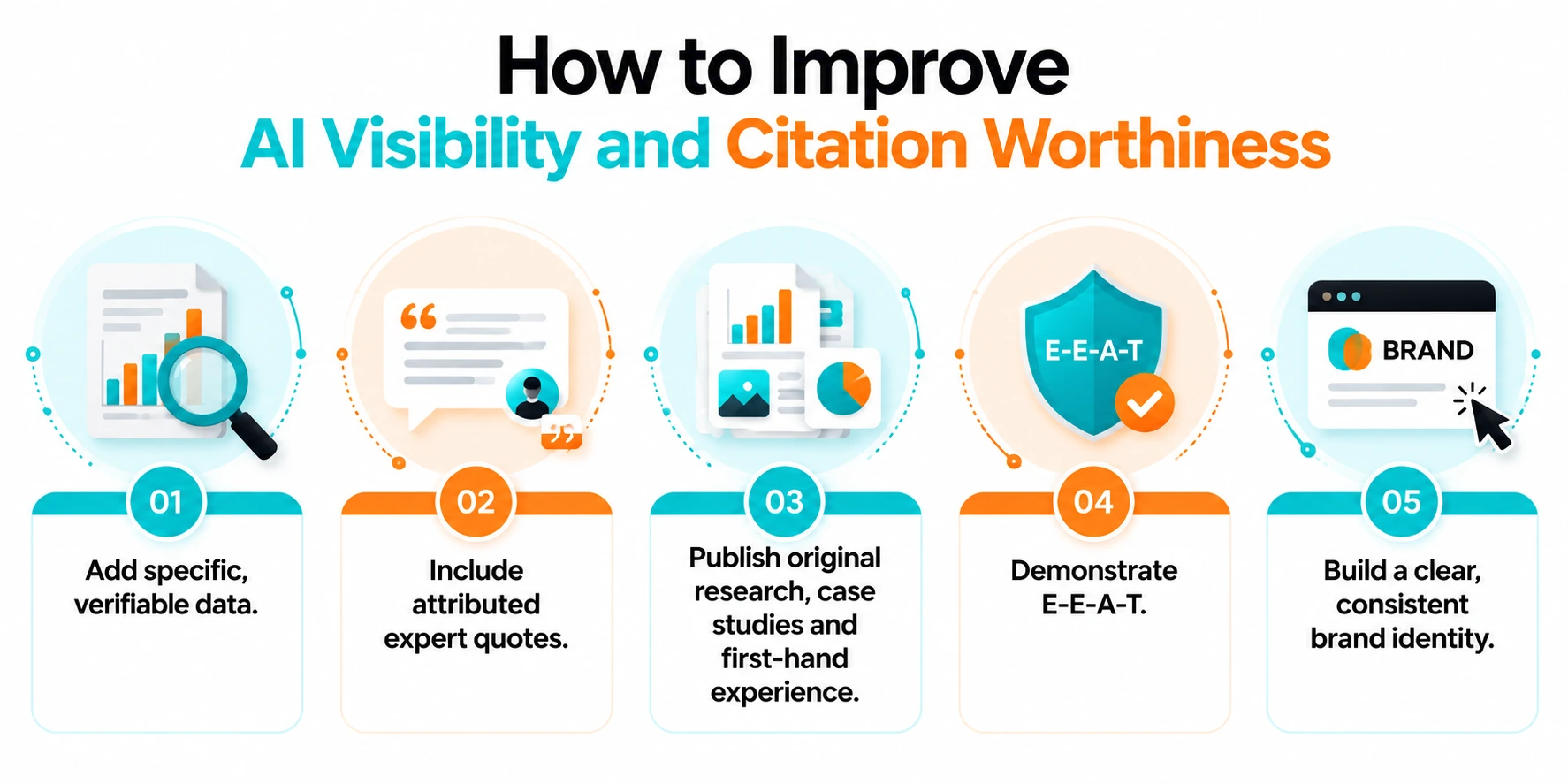
If you want to improve AI visibility and citation worthiness, start with the substance of what you publish. Before any technical tweaks, ask a blunt question: would an AI model have a good reason to quote this page over the other nine it could pick? These five habits give it one.
Add specific, verifiable data
Vague claims like “many businesses are switching” give an AI model nothing to hold onto. A sourced number does. SE Ranking’s analysis of 129,000 domains found that pages with 19 or more statistical data points averaged 5.4 ChatGPT citations, compared with 2.8 for data-light pages.
A few rules keep this honest and useful:
-
Name the source and the year next to every statistic.
-
Link to the original study, not a blog that summarized it.
-
Use recent figures. A 2021 number in a 2026 article signals neglect.
-
Put the stat inside a self-contained sentence so it still makes sense when lifted out of context.
Include attributed expert quotes
Quotes give AI systems a clean, attributable unit of authority. The keyword is attributed. “Experts say” does nothing. A named person with a role and a company does. If you have in-house specialists, quote them. If you don’t, interview someone in your industry and publish the takeaways.
Publish original research, case studies, and first-hand experience
This is the hardest tactic and the one with the best payoff. Generic advice can be written by anyone, and AI models can already generate it themselves. What they can’t do is invent your survey results, your campaign numbers, or your lessons from real projects.
You don’t need a 5,000-respondent study. A small client dataset, a before-and-after case study, or a quarterly look at your own analytics can all work, as long as the method is stated and the numbers are real. If you’re looking for an example of how this reads in practice, our own case studies lay out the problem, the approach, and the measurable outcome in that format.
Demonstrate E-E-A-T
Experience, expertise, authoritativeness, and trust aren’t just a Google concept anymore. They’re what any retrieval system is trying to approximate. Show real authors with bios and credentials. Add dates and review notes. Cite your sources. Make it easy to find your About page, contact details, and physical address. Mention first-hand involvement (“we tested,” “in our audit of 40 sites”) where it’s true.
Build a clear, consistent brand identity
AI models link information across the internet. If your company is listed as "Acme Digital" on your website, "Acme Marketing Co." on LinkedIn, and "AcmeDigital LLC" in directories, you are making it difficult for models to see those as one entity. Keep your name, description, services, and essential facts the same across your website, social accounts, review sites, directories, and press coverage. Explain what you do in a clear sentence wherever Acme Digital appears.
How to Optimize Website Content for AI Citation
Quality gives you a shot. Structure decides whether the model can actually use it. To optimize website content for AI citation, write every page so that a machine can extract the answer in seconds.
Use an answer-first structure
Put the direct answer in the first one or two sentences under each heading, then add context, nuance, and examples. If a heading asks “How long does SEO take?”, the next line should say something like “Most sites see early movement in three to six months, though competitive terms can take longer.” Don’t warm up with three sentences of background first. Journalists call this the inverted pyramid, and it happens to suit AI retrieval very well.
Write for questions, not just keywords
People use AI tools by writing sentences. The prompts that they send are longer and more detailed than the short search queries. Build. Subheadings around the real questions that customers ask. Pull those questions from sales calls, support tickets, the "People also ask" boxes, Reddit threads, and your own site search data. A page that answers one question well often outperforms a page that loosely covers ten questions.
Format for easy extraction
AI systems like pages they can parse cleanly. AirOps and ConvertMate both found that cited pages overwhelmingly use a tidy heading hierarchy, with one H1 and sequential H2s and H3s. Tables, numbered steps, and short bullet lists also get lifted often, particularly for comparisons and processes.
That doesn’t mean you should chop everything into bullets. It means each section should be skimmable, self-contained, and clearly labeled.
Keep language plain and conversational
Write the way a knowledgeable colleague would explain it. Skip the jargon, the filler and the “in today’s fast-paced digital landscape” openers. Define terms the first time you use them. Short sentences next to longer ones read naturally and are easier for both people and models to process.
Refresh content regularly
Freshness isn't just nice to have. Seer Interactive found that 85% of AI Overview citations come from content published in the last two years. That means staying matters. Set a review schedule: check your pages every quarter. For the rest, review them twice a year. Update the stats, replace old screenshots, and add new sections where needed. Always show a visible "last updated" date. Don’t just change the date. That doesn’t work. People notice. Only real edits count.
How to Optimize Site Visibility for AI Assistants
Content can be perfect and still go uncited if machines can’t reach it or understand who’s behind it. To optimize site visibility for AI assistants, check the technical layer.
Make sure AI crawlers can access your site
Open your robots.txt file and look at what you’re blocking. Many sites added blanket rules against AI bots in 2023 and 2024 and forgot about them. The main user agents to know are GPTBot, OAI-SearchBot and ChatGPT-User (OpenAI), PerplexityBot, ClaudeBot (Anthropic) and Google-Extended, plus Googlebot, which feeds AI Overviews. Decide deliberately which ones you want to allow. If your goal is to be cited, blocking the retrieval bots works against you.
Also keep in mind that many AI crawlers don’t execute JavaScript well. If your key content only appears after client-side rendering, it may be effectively blank to them. Server-side rendering or static HTML for important pages is the safer route.
Add schema markup
Schema markup helps search engines understand what your page is about without having to guess. Focus on using Organization, Article, Author (Person), FAQPage, HowTo, Product, and LocalBusiness schema where relevant. Use the property to connect your official social media profiles and directory listings. Always check your schema with Google’s Rich Results Test to make sure it’s correct and matches what users see on the page.
Improve page speed and Core Web Vitals
Slow, heavy pages get crawled less. Cause visitors to leave quickly. Aim for performance in Largest Contentful Paint, Interaction to Next Paint, and Cumulative Layout Shift. Compress images, remove code, and reduce unnecessary scripts. If your current site build is slowing things down, consider a rebuild or a thorough cleanup. Our website development services are designed to create easily crawled and machine-friendly pages; this is exactly why we do it.
Structure your site clearly
Organize your content into topic clusters. Link pages logically and use clear, descriptive URLs. Include breadcrumbs to help users and search engines navigate. Build a pillar page for each topic, then support it with detailed articles that link back to it. This shows depth and relevance. Fix orphan pages, fix chains, and eliminate duplicate content. Keep your XML sitemap updated. Some teams are also trying out a file to guide AI models to important pages. There’s no proof that search engines depend on it yet, so treat it as a simple low-effort task, not a major strategy.
Use headers and footers to reinforce entity signals
Your header and footer appear on every page, so they’re ideal for reinforcing who you are. Include your business name, a short description, your location or service area, contact details, and links to your main service pages, About page, and key profiles. Keeping this information consistent across every page helps AI systems associate all your content with one consistent entity.
How to Improve AI Citations Beyond Your Own Website
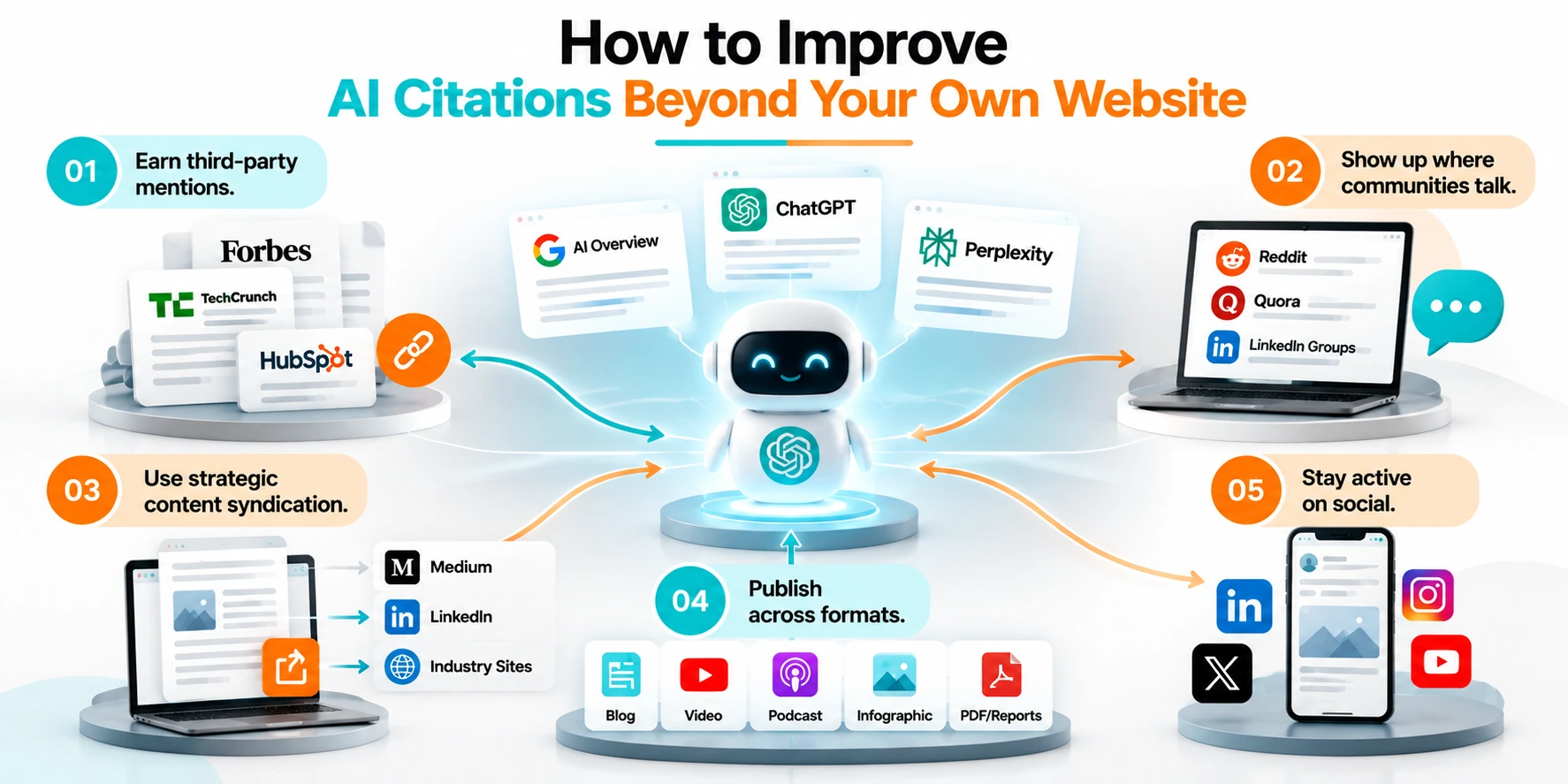
If you’re serious about learning how to improve AI citations, you have to look past your domain. Most of the sources AI tools cite are pages you don’t own, which means your off-site footprint is half the game.
Earn third-party mentions
Try to get coverage in industry publications, trade press, review sites, podcasts, analyst roundups, and best‑of lists that match your category. Digital PR, expert commentary, guest contributions, and original data that journalists want to cite all help. Quality matters more than volume. One mention in a publication that your audience trusts is worth more than twenty low‑grade directory links. I have seen that a single mention can do more for your brand than low‑quality links.
Show up where communities talk
Reddit, Quora, Stack Exchange, niche forums, and LinkedIn groups feed AI answers heavily. Reddit alone accounted for roughly 24% of citations in Perplexity in January 2026. Participate as a genuine contributor. Answer questions properly, disclose your affiliation, and avoid link-dropping. Communities spot self-promotion quickly, and moderators remove it just as fast.
Use strategic content syndication
Republishing selectively on reputable platforms such as LinkedIn articles, Medium, industry hubs or partner sites can widen your footprint. Do it carefully: publish on your own site first, use canonical tags or clear attribution pointing back to the original, and choose outlets that AI tools already cite. Mass syndication to low-quality sites does more harm than good.
Publish across formats
YouTube’s share of citations in Google AI Mode and AI Overviews roughly quadrupled between January and April 2026. Turn your best articles into short explainer videos, add transcripts, and create podcasts, slide decks, and infographics. One solid piece of research can become five assets, each giving AI systems another route to your brand.
Stay active on social
Social posts aren’t always cited directly, but they reinforce brand signals, spread your content, and give journalists and creators reasons to reference you. Keep your profiles complete and consistent, post expertise rather than ads, and engage with others in your space.
How to Gain Insights Into AI Search Rankings and Track Your Progress
Traditional rank trackers can’t tell you whether ChatGPT recommends you. To gain insights into AI search rankings, you need a different measuring stick, and honestly, a bit of patience, because AI answers vary from one run to the next.
Start with manual prompt testing
Before buying any tool, build a list of 20 to 30 prompts your customers would realistically ask, such as “best [your service] for [audience],” comparisons, “how to” questions, and “what is” definitions. Run each one across ChatGPT, Gemini, Perplexity, Claude, and Google AI Mode. Do it in logged-out or fresh sessions, repeat each prompt a few times, and log whether you were cited, mentioned, or absent, and who was cited instead.
Metrics to track
-
Citation frequency: how often your domain is linked as a source.
-
Brand mention rate: how often you’re named, even without a link.
-
Share of voice: your mentions versus competitors across the same prompt set.
-
Sentiment and accuracy: whether the AI describes you correctly and positively.
-
Referral traffic: visits from chatgpt.com, perplexity.ai, gemini.google.com, and similar sources in GA4.
-
Branded search growth: a rise here often follows increased AI exposure.
-
Conversions from AI referrals: these visitors are often further along in their decision, so quality can beat volume.
One caution: don’t assume Google Search Console tells the full story. One published 2026 test found only about 2% of a site’s AI citations matched pages it ranked for on Google. The pages AI picks may not be the ones you expect.
Competitor gap analysis
For every prompt where a competitor is cited and you’re not, open the cited page and study it. Is it more recent? Does it include original data? Is it formatted as a table or comparison? Is it on a platform you’re absent from, like Reddit, YouTube or a review site? Those gaps become your content and outreach roadmap.
Tools to consider
A growing set of platforms track AI visibility at scale, including Semrush’s AI visibility features, Ahrefs Brand Radar, Profound, Peec AI, Goodie and Otterly. They differ in prompt volume, platforms covered, and price, so run a trial in your own category before committing. Pair them with GA4 and Search Console for the traffic side of the picture.
Best Practices for Improving Visibility in AI Search Results
If you want the short version of best practices for improving visibility in AI search results, or simply how to improve visibility in AI search results without overhauling everything at once, here’s the checklist we’d work through:
-
Let crawlers in. Audit robots.txt and make sure your key content renders without heavy JavaScript.
-
Lead with answers. Put the direct answer under each heading before the explanation.
-
Back claims with sourced data. Use recent, linked statistics with the year and publisher named.
-
Quote real people. Attribute expert quotes by name, role, and company.
-
Publish something only you can. Original research, client results and first-hand lessons beat rewritten advice.
-
Mark it up. Use schema for your organization, authors, articles, FAQs and products.
-
Keep it fresh. Review priority pages every quarter and update them substantively.
-
Be consistent everywhere. Use the same brand name, description, and facts on every profile and listing.
-
Build your off-site presence. Earn press mentions, join community discussions, and publish video.
-
Measure and adjust. Run the same prompt set monthly and compare against competitors.
None of this replaces traditional SEO. A fast, well-structured, authoritative site still underpins everything, and Google AI Overviews still draw heavily from pages that rank. Think of AI visibility as an extension of good SEO with a stronger emphasis on evidence, structure, and reputation.
Conclusion
Being cited by AI platforms comes down to being the most useful, most credible, and easiest-to-quote source on a given question. That means publishing specific, verifiable information, structuring it so machines can extract it, keeping it current, and building a reputation that extends beyond your own domain. It’s ongoing work rather than a one-time fix, but the brands that start now are building an advantage that gets harder for competitors to close.
If you’d rather not figure it out through trial and error, DIGITECH India can help. Our team builds AI-ready content, technical foundations, and off-site authority for brands that want to be found in both traditional and AI-driven search. Explore our AI SEO services or get in touch for a free consultation, and we’ll show you where your brand stands in AI answers today and what it will take to improve it.


