

 Written by
Most businesses realize that they need to appear on Google. Far fewer know what it takes to get there. Others believe that to perform organic SEO marketing, they must add some keywords to a page. Others view it as a project that is done only once. It's actually a system of research, technical solutions, content, authority building, and measurement.
The channel is worth it. According to BrightEdge research, organic search drives the most traffic to a website, at 53%, compared with paid search and social media, which account for only 5% respectively. This means that organic search is the cornerstone of most digital growth strategies.
This guide explains all the steps you need to take to do a check of your website and make it better for search engines such as Google. You will learn how to see if an agency is doing everything they should if you want to do it yourself or if you want to check them out.
What Is Organic SEO Marketing?
Organic SEO marketing is a plan that includes making your website so it appears in the natural search results. You do this by making your site easier for search engines to find and more useful for people who are looking for information. You also make your site more trusted by people who are browsing the web. There is no cost for each click. Getting to the top depends on how relevant your content's how good the quality is and how much authority your website has.
There are three main aspects:
-
Technical SEO: crawlability, renderability, and indexability of your site by search engines
-
On-page SEO: how well each page aligns with the searcher's intent
-
Off-page SEO: what efforts your brand makes to gain trust and authority from other websites
These are the two pillars of an SEO marketing plan.
Organic SEO vs. Paid Search Marketing
Both channels put you in front of people who are searching, but they work very differently.
|
Factor |
Organic SEO |
Paid Search (PPC) |
|
Cost model |
Investment in content, technical work, and links |
Pay per click |
|
Speed |
Gradual, builds over months |
Immediate |
|
Longevity |
Rankings can last long after the work is done. |
Stops when budget stops |
|
Trust |
Often seen as more credible |
Marked as ads |
|
Best for |
Sustainable, compounding growth |
Quick tests, launches, promotions |
They work best together. PPC gives you fast data and traffic while organic rankings build. If you are weighing both, read our guide on what to expect from a monthly PPC management service.
Step-by-Step Guide to Organic SEO Marketing Success
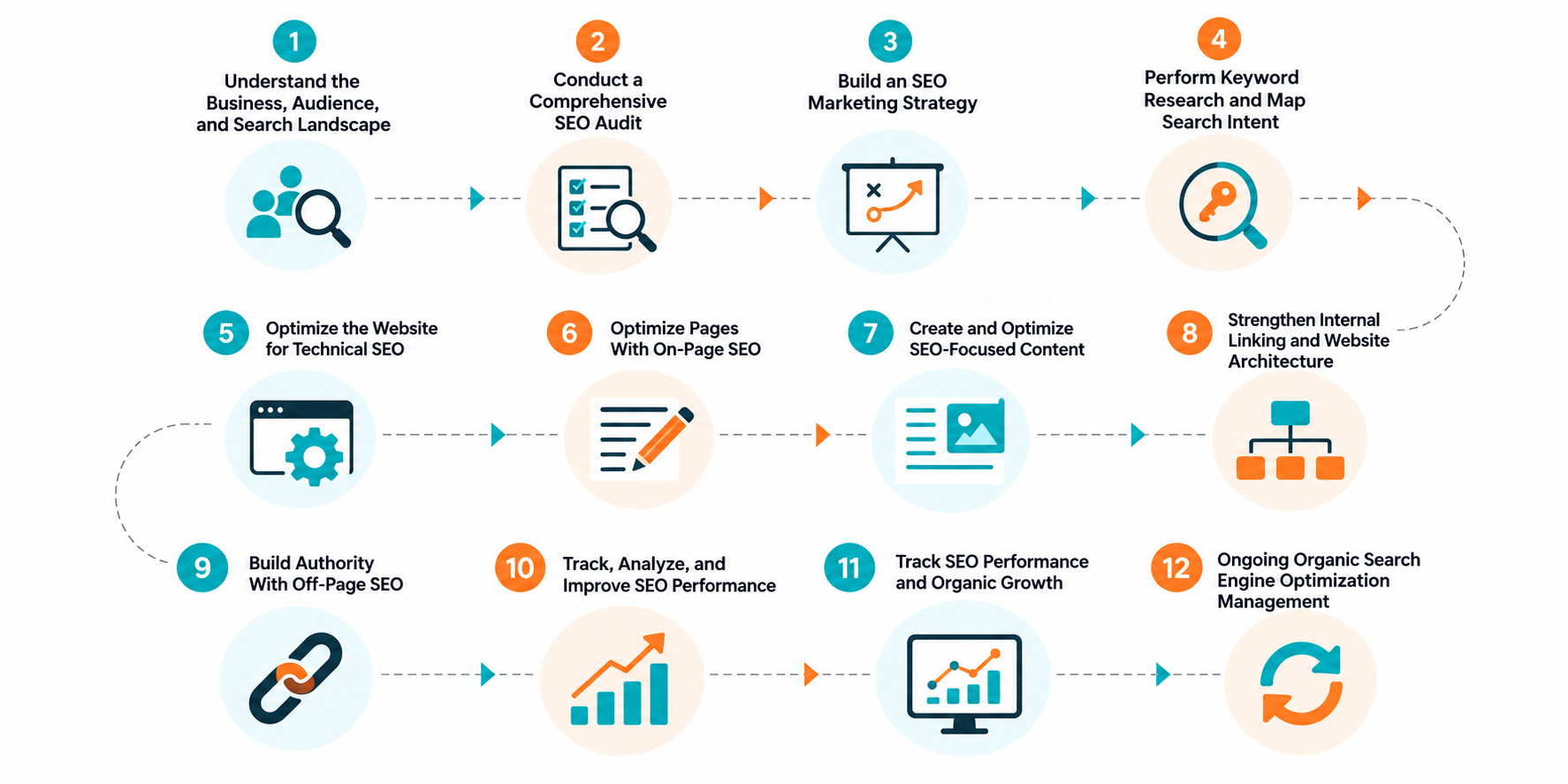
Here is the full process, from first discovery call to long-term growth. Follow these steps in order, and you will cover everything that matters for organic search engine optimization management.
Step 1: Understand the Business, Audience, and Search Landscape
Tools are not the start of SEO. Tools are the start of becoming an entrepreneur who knows business, knows customers, and knows competitors. Before you look at the website, ask yourself these questions:
-
What is the business’s product or service, and which product or service brings in revenue?
-
Who are your target customers? What problems do your target customers face?
-
Who are the players in the search game? These players are usually different from business rivals.
-
What do your search results look like for the topics you care about? Do you see text, local packs, video, or AI-generated answers?
This foundation keeps your SEO work linked to business goals, such as getting leads, making sales, and securing bookings, rather than only chasing vanity traffic.
Step 2: Conduct a Comprehensive SEO Audit
An audit helps you see what's going on right now. It should consist of three sections.
Technical SEO Audit
Discover how your website appears to search engines. Look closely at crawlability, indexing, XML sitemaps, robots.txt, site speed, mobile usability, HTTPS, redirects, broken links, duplicate content, and errors in data. All of these factors influence SEO Audit success.
On-Page SEO Audit
Check title tags, meta descriptions, headings, depth of content, keyword density, image alt text, and internal links on the page. Identify pages that're thin, old or competing with each other. This review is a part of the on-page SEO audit.
Off-Page SEO Audit
Perform a profile analysis of backlinks. Look at how links you have how good they are what anchor text they use and whether any links are toxic or spammy. Compare these findings with competitors to gauge authority. This analysis is part of the Off-Page SEO audit.
Step 3: Build an SEO Marketing Strategy
The audit shows what is not working. The strategy shows what to fix. A strong SEO marketing strategy takes the audit results. Turns them into a clear plan. This plan has priorities, people, deadlines, and goals for what should happen.
What Should an SEO Marketing Strategy Include?
-
Goals that match business objectives and key performance indicators
-
Understanding of the target audience and how competitors are doing
-
Keywords and groups of related topics
-
A list of technical issues to fix in order of importance
-
Plan for optimizing web pages and content
-
Content calendar based on what people search for
-
Approach to getting quality links and building digital PR
-
Plans for local SEO, e-commerce SEO, or international SEO if needed
-
Schedule for reporting and regular check-ins
Good SEO management means keeping this strategy updated. Rankings change. Competitors move. Search engines update algorithms. So the plan must adapt. Priorities shift over time. Staying active with the plan keeps SEO efforts.
Step 4: Perform Keyword Research and Map Search Intent
You can discover what your audience is searching for on Google by doing keyword research. Begin with seed keywords, then use tools like third-party platforms, Google Keyword Planner, and Search Console to find more. Look at search volume, how hard it is to rank, and how relevant the keyword is. Its commercial value for each term.
Turning Keywords into Search Intent
A keyword by itself doesn’t tell the story. You also need to know why someone is searching. Search intent usually comes in four forms:
-
Informational: For example, "how to do SEO”. People want to learn or understand something.
-
Commercial: Like " organic SEO solutions”. Users are comparing options before buying.
-
Transactional: Such as "hire SEO company”. They are ready to take action or make a purchase.
-
Navigational: Searching for a brand or page like "Google Search Console."
Match each keyword to the kind of page. Informational queries need guides or blog posts. Commercial ones need comparison articles or reviews. Transactional ones need service pages or product pages. When the intent doesn’t match the page, that’s often why even good content fails to rank.
Step 5: Optimize the Website for Technical SEO
Address the audit findings. Typical priorities consist of:
-
Improving Core Web Vitals and page speed following Google’s Core Web Vitals guidelines.
-
Making the website fully mobile-friendly.
-
Fixing chains, broken links, and crawl errors.
-
Keeping XML sitemaps up to date. Submitting them.
-
Using tags to fix duplicate content.
-
Adding data (schema) so search engines can understand your content better.
The foundation is health. Great content will suffer on a website that search engines cannot crawl well.
Step 6: Optimize Pages With On-Page SEO
On-page SEO tells search engines and users what each page is about. For every important page, optimize:
-
Title tag and meta description
-
One clear H1 with supporting H2 and H3 headings
-
Primary and related keywords used naturally
-
URL structure
-
Image file names, compression, and alt text
-
Internal links and clear calls to action
What Is Organic SEO Placement?
The position your page receives in natural search results for a particular query is known as organic SEO placement. It is not purchased. It is the outcome of how well your page fulfills search intent and how much trust has been established on your website. Because higher placement typically results in more clicks, authority, content quality, and on-page optimization all serve the same purpose.
Step 7: Create and Optimize SEO-Focused Content
Content, after all, is what search engines rank and what will keep visitors on site. Google's own guide emphasizes that instead of being rank-oriented, you should focus on creating content that is useful, reliable, and user-first.
How to Do Organic SEO Through Content
If you are wondering how to do SEO with content, follow this process:
-
Use keyword and intent research as inspiration for topics. Do not guess.
-
Learn the organic SEO best practices. Make observations about what they do and do not cover.
-
Do something productive for organic SEO. Include thoughts, examples, information, and organization.
-
Optimize the page for SEO. Employ headings, FAQs, tables, and images to assist where appropriate.
-
Refresh regularly for SEO. Keep stats up to date old recommendations and add to thin sections.
Content is also where you build authority for organic SEO. Publishing connected pieces on a theme shows search engines you cover the content topic in depth.
Step 8: Strengthen Internal Linking and Website Architecture
Internal links pass authority between pages and help both users and crawlers find content. Good architecture means:
-
A logical hierarchy: homepage, categories, subcategories, then individual pages
-
Important pages reachable within a few clicks
-
Descriptive anchor text, not "click here"
-
Links from high-traffic blog posts to relevant service pages
-
No orphan pages with zero internal links
Step 9: Build Authority With Off-Page SEO
Search engines treat quality links from trusted sites as endorsements. Effective off-page SEO includes:
-
Earning links through original research, tools, and helpful resources
-
Digital PR and media mentions
-
Guest contributions on relevant industry sites
-
Business listings and brand citations
-
Brand mentions on platforms where your audience already is
Quality beats quantity. A few relevant, authoritative links outweigh hundreds of low-quality ones. Be careful with shortcuts too. Our articles on barnacle SEO and parasite SEO risks and best practices explain which off-site tactics are worth considering and which carry risk.
Step 10: Track, Analyze, and Improve SEO Performance
SEO is never "set and forget." Once the work is live, review what is happening and fix what is not working. Use this table to diagnose common problems:
|
SEO Issue |
Potential Organic SEO Solution |
|
Pages not indexed |
Check robots.txt and noindex tags, submit sitemaps, fix crawl errors, and improve internal links to those pages |
|
Low rankings |
Improve content depth and intent match, optimize titles and headings, and build relevant backlinks |
|
Declining traffic |
Audit for algorithm impact, lost links, outdated content, or technical issues, then refresh and re-optimize |
|
Keyword cannibalization |
Merge or differentiate competing pages, assign one primary keyword per page, and use canonicals where needed |
|
Weak authority |
Invest in digital PR, original research, and quality link acquisition |
|
Poor internal discovery |
Add contextual internal links, improve navigation, and fix orphan pages |
|
Content gaps |
Run competitor and topic gap analysis, then publish content for missing queries |
|
Poor conversions |
Improve CTAs, page layout, load speed, trust signals, and match content more closely to user intent |
Step 11: Track SEO Performance and Organic Growth
If you don't measure it, you can't manage it. Install Google Analytics 4 and Google Search Console from the start and check on a regular basis.
Key Organic SEO Metrics
-
Unpaid search: all traffic from search engine results pages that did not include paid traffic.
-
Impressions & CTR: how often you pop up & how often people click
-
Ranking keywords: ranking of the keywords in priority
-
Indexed Pages: The number of pages that Google has saved
-
Conversions and leads: form fills, calls, purchases from organic visitors
-
Backlink Growth: New ref domains, ref domain quality
-
Google Core Web Vitals: loading, interactivity, and visual stability.
Why Rankings Alone Are Not Enough
Even with a high ranking, a page may not generate any income. It may send users to a site that does not convert, target the incorrect intent, or have a weak headline that receives few clicks. Visibility is indicated by rankings. The effectiveness of such visibility is demonstrated by traffic, engagement, leads, and money. Report them together at all times.
Step 12: Ongoing Organic Search Engine Optimization Management
Search results are constantly updated. New content is published by the competitors, algorithms change, and users' behavior evolves. That's why organic search engine optimization management is a process and not a project with an end date.
What Does Ongoing SEO Management Include?
-
A monthly technical health check is performed.
-
Content updates and new content production.
-
Ranking and traffic monitoring.
-
Competitor tracking
-
Link building and PR results in ongoing results.
-
Conversion improvements
-
Clear next steps included in regular reporting.
Consistent SEO marketing management is what turns early gains into lasting results.
How Long Does Organic SEO Marketing Take to Show Results?
Most businesses should expect movement within three to four months and stronger results between six and twelve months. Exact timing depends on competition, site authority, content quality, and how much fixing is needed at the start.
The data supports an approach. An Ahrefs study found that one point seven four percent of newly published pages reach the top ten within a year and seventy-two point nine percent of top‑ten pages are more than three years old. In words, rankings are earned over time.
Some results come faster. Fixing errors, optimizing existing pages, and targeting lower‑competition keywords can show results in weeks. Broader growth for terms takes longer, but it compounds, and that is the real advantage of organic over paid.
Organic SEO Marketing vs Other Search Marketing Approaches
|
Approach |
Primary Focus |
Main Mechanism |
|
Organic SEO |
Long-term visibility in unpaid results across the whole site |
Technical optimization, quality content, and authority building |
|
PPC |
Immediate visibility and traffic |
Paid bids on keywords and audiences |
|
Local SEO |
Visibility for location-based searches and map results |
Google Business Profile, citations, reviews, and local content |
|
Content Marketing |
Attracting and engaging an audience with useful content |
Blogs, guides, videos, and resources that earn traffic and links |
What Does a Complete Organic SEO Service Include?
What Does a Complete Organic SEO Service Include?
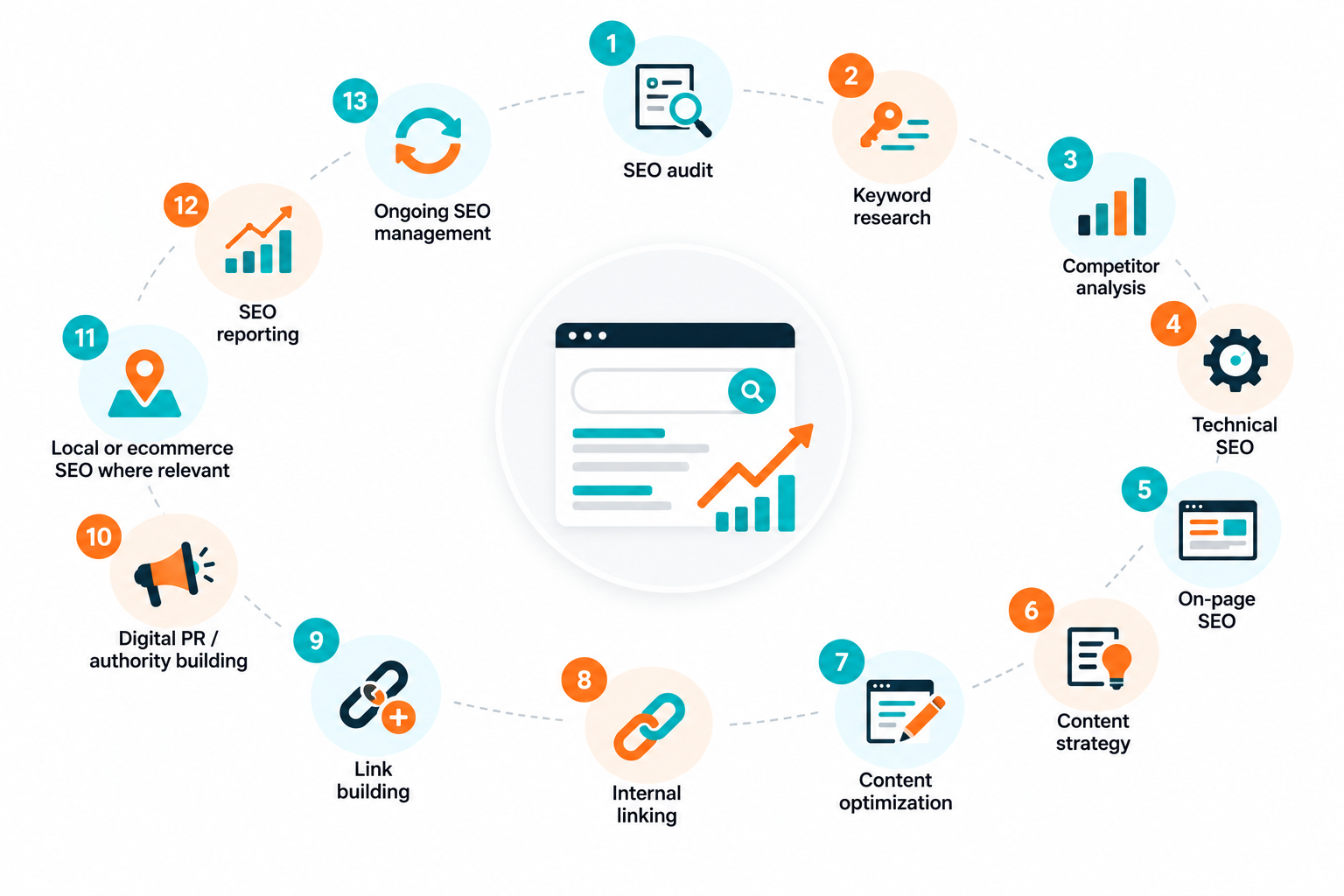
If you are asking what organic SEO services are, it is the full package of work needed to earn and keep rankings. A complete offering should include:
-
SEO audit: a health check of technical, on-page, and off-page factors
-
Keyword research: finding valuable, relevant search opportunities
-
Competitor analysis: learning what is working for others in your space
-
Technical SEO: fixing crawling, indexing, speed, and structure issues
-
On-page SEO: optimizing titles, headings, content, and metadata
-
Content strategy: planning topics around search intent and business goals
-
Content optimization: improving existing pages for better performance
-
Internal linking: building a clear structure that spreads authority
-
Link building: earning quality backlinks from relevant sites
-
Digital PR and authority building: growing brand credibility and mentions
-
Local or ecommerce SEO where relevant: specialized tactics for your business model
-
SEO reporting: clear metrics tied to leads and revenue
-
Ongoing SEO management: improvement and adjustment
Good organic SEO solutions are tailored to your business, not copied from a template. For proof of what this looks like in practice, see how our SEO work helped an Arizona cafe reach 337K impressions and 2.88K clicks.
Conclusion: Organic SEO Is an Ongoing Growth Process
Organic SEO marketing is not a single task. It starts with understanding your business and audience, moves through audits, strategy, keyword research, technical fixes, content, and authority building, and continues with measurement and refinement. Each step supports the others, and the results build on themselves over time.
If you want expert help with your organic SEO marketing, from the first audit to ongoing management, connect with DIGITECH India. Explore our organic SEO services or contact our team for a free consultation, and let's build a search presence that keeps growing.


